Helicopter Search and Rescue near Haiphong North Vietnam LT Ron Ball Rescue
By Rescue Pilot
Update (8/30/13): [Webmaster: This piece was received on how Lt. Ron Ball was shot down.]
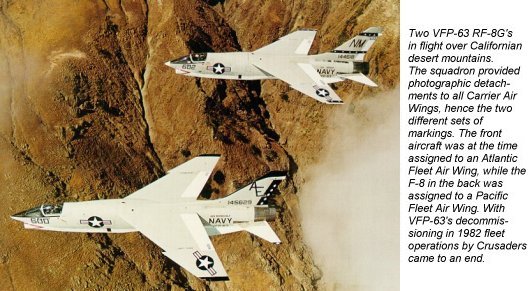
Again I was assigned to fly escort on a photo mission, to determine what type of AAA had been moved into the karst ridge area from which an aircraft was shot down, during egress from a raid on Hanoi, the day before. Since we had flown together many, many times and the actual photos over land (part of the mission) was to take less then three minutes, Ron [Ball] still instilled confidence even during the rather short briefing. I was to lead, ostensibly due to having a radar with which to pin point coast in location, then pop up to 500' passing lead, so Ron could take forward looking photos crossing the beach, breaking 90 degrees, take lateral photos, then 90 degrees again descending back down to wave tops and egress.
BUT! On this day, neither the two carrier air wings' joint, three or four mission raids into the North, with many different types of aircraft per mission, nor, rooster tail flat hatting, for some 30 minutes, diverted attention from our two F-8 Crusaders, for when we passed some fishing boats and popped up, the AAA lit up. Ron crossed the beach, with tracers going in several directions, then broke 90 degrees. While belly up to me a tracer crossed my nose entering the center of his aircraft (main fuel cell), immediately catching fire, so I broke radio silence with a couple of 'Ron?' pause, 'Ron?", then he finely said calmly, "I think I have been hit" which I confirmed by telling him he was on fire, go gate.
Ron smoothly pulled around and down toward the water to get under the AAA and out to sea. Quickly passing the fishing boats and out of range of shore guns, then he started a smooth climb while I was calling for support and rescap.
At approximately three or so thousand feet I told him that I could see through the aircraft, both main gear and hook were hanging out burning, and to think about getting out; he said "temp is going through 1000 degrees, "I'll see you back at the ship." The canopy came off, seat came out, aircraft exploded within fraction of seconds and then the separation and beautiful chute. The rescue went well and as someone has said "the rest is history."
Hal Loney, F-8 1963-1976
(8/28/13): Dick and I were scheduled to fly together on 19 April 1966 and were being pre-positioned up north to support an Alfa Strike, a major attack incorporating a large number of aircraft, going into North Vietnam. We lifted off the deck of Yorktown at 0800 and headed first to Kitty Hawk (Pawtucket) for a logistics support mission before proceeding on assignment. That early launch, coupled with the nature of mission, made it obvious that we would be spending a long day in the air and as events unrolled, that assumption was absolutely correct.
When we launched that morning, there was no way of foretelling the events about to unfold, but we had someone with us to chronicle the entire day's activities. In a rare move we had been asked to fly an additional crewman with us, a CHINFO photographer, who was hoping for a chance to shoot some actual combat pictures of a rescue in the north. For our part, we were hoping he wouldn't get the chance.
After a short stop at Pawtucket, we lifted off and headed first to the south SAR station where we dropped off their mail about 1000 before heading on up for a day of fun and games with our old friends [USS] Coontz and Rogers.
We reached our North SAR destination where upon arrival we were informed that Harbor Master, the Task Unit Commander, had directed that we remain on station until 1800 when the last strike aircraft would be coasting out of Indian territory. At least now we had framed the events for the day, and it was going to be a long one, not less than ten hours any way we chose to look at it. Remembering my earlier experience with my admiral, I requested that they inform Yorktown of our tasking, and we settled in for the day.
We had grown to appreciate USS Rogers more than USS Coontz because they always treated us better. We pretty much had our option of which ship to refuel from, but fuel also meant food and drink. These were the guys who kept our batteries charged throughout the day.
We would say something like "Steel Hawser (Coontz), Big Mother is going to need gas in about thirty minutes. We'd appreciate some box lunches."
"Roger, Big Mother, we have bologna sandwiches today, and we'll get you some water." Bologna was not the term used throughout the navy for that variety of sandwich meat, however.
Almost immediately the radio would invariably come alive with another call.
"Big Mother, this is Bulls Eye (Rogers), we're preparing steak sandwiches for you right now. We'll be ready to receive you whenever you're ready. We've also got a gallon of bug juice for you to wash it down with."
Little wonder that we liked Rogers best, not that it made a lot of difference to either of them. Rogers was just a better run ship, at least from our stand point, and they were good at providing top notch service.
We had been on station for some time, when about 1530 we received a call from Steel Hawser.
"Big Mother six eight this is Steel Hawser, over."
"Steel Hawser this is Big Mother six eight, go ahead."
"Big Mother six eight this is Steel Hawser, be advised I'm painting an emergency squawk on my gadget, over."
Within seconds of that call we heard a May Day report from a Cork Tip aircraft over the Haiphong complex.
"Big Mother six eight this is Steel Hawser, your vector is three zero three at thirty eight miles. Cork Tip six zero one is down. We're trying to establish his exact location."
We picked up the directed vector and pushed the speed to red line.
"Steel Hawser this is Big Mother six eight; interrogative operation feet wet?" I asked.
What I was asking was whether we were going inland (feet dry) or would be operating over water (feet wet). Clearly we wanted to hear that we would be able to remain over the water because that significantly increased everybody's prospect of surviving this ordeal.
"Unknown at this time, Big Mother."
Looking at our charts and the vector we were given, it looked as if we were going inland, so I directed the crew to don parachutes and flack vest. We were too busy to be afraid of what lay ahead of us, but we were headed into Haiphong Harbor, one of the heaviest defended areas in all of North Vietnam. At that point we didn't know if we would have to take the downed pilot away from troops in downtown Haiphong or would we find him stroking out to sea in his raft. While mulling that over in our thoughts, our friends and protectors, the ever-present A-1 Skyraders joined on our port wing.
It would be impossible for me to adequately describe just how those powerful war birds, a beautiful sight under any circumstances, made us feel, even as we headed into the heart of Indian country. They were much like your American Express card. We didn't want to leave home without them. Our absolute survival depended on the skills and daring of those pilots, and I knew we were in good hands anytime they were around. I would trust them with my life, and I did.
"Woop, woop, woop, woop, woop." There was no other sound in the world like that of a survival radio beeper. We had heard it many times before, and it always meant the same thing; a pilot was down. The uniqueness of that sound was such that anytime I heard it, a shiver would crawl up my spine, even years after the war. Hearing that radio was great, though. We now had the ability to get an exact location. Dick switched the radio over to the ADF (automatic direction finding) position, and we watched as the needle swung around and pointed to the source of the signal. We knew the absolute course now, but we still didn't know if we would be operating over land or in the harbor.
Our second A-1 had sprinted ahead into the area and shortly thereafter, he reported that he was over the pilot who was in his life raft and appeared to be in good shape. He was feet wet but just barley. He was within half a mile of the beach and was located to the east of downtown Haiphong about eight miles away.
That was great news. The farther we could get from the Haiphong complex the better. To give us a little greater edge, it appeared God was on our side once more. As we approached the area, we ran into a fog bank. It was not very thick because the A-1 could see down through it from above, but that fog became our best friend. It kept the North Vietnamese from seeing us from afar. You can't shoot what you can't see.
We continued to follow the ADF needle right to the pilot. As we passed over him, he lit a day smoke to give us the wind line. Passing over him I pulled back on the stick and rolled hard as I kicked the rudders around. As I rolled the helicopter over on its side, I started to release the pressure on the stick and pushed the nose back toward the ground as we reversed direction. That wing over maneuver brought us back into the wind, what little there was, and lined us up on the survivor.
We could see land a short distance away from us, and the A-1's reported junks in the area although we could see none through the fog. It was obvious that someone could see us, or at least hear us, though. As we entered a hover, rounds started to hit the water around the area. Since I could not see who was shooting at me, I was reasonably confident that they were not an immediate threat. It was all small arms that even if we did take a hit, it would not likely knock us out of the sky. There was even a good chance they could not see us at all and were just shooting at the sound of the helicopter.
I brought the helicopter into a hover over the pilot who was still in his raft. That always caused a problem because the rotor wash pushed the raft across the water, at times with surprising speed.
"Pilot, after station; the survivor is still in his raft," my crewmen said.
"Roger, after station. I'll keep it in a high hover."
That meant I would hover at sixty-feet to limit rotor wash, but shortly after that, the after station called to say that we were too high. Not watching my instruments, I had inadvertently climbed to a ninety-foot high hover. Was there a littler adrenaline running through my body or what? Regardless, my mistake took valuable time, and time was the enemy. Fortunately for everyone, as I lowered the helicopter to the proper altitude, the pilot exited his raft. Shortly thereafter, we had him aboard.
By now the CHINFO photographer was shooting away and in the process, he got the first actual photos of a combat rescue in North Vietnam. The picture that was on virtually every major newspaper across the country showed Lieutenant Ron Ball looking up as he was being hoisted aboard Big Mother six eight. I told the lieutenant that we had just made him famous, but he had no idea what I was talking about.
Lieutenant Ball had been flying an RF-8, photo reconnaissance aircraft, from VFP-63 off USS Ticonderoga when he was shot down. He was on his last flight of the cruise and told me that as he sat on the catapult that day, he knew he was going to get "bagged." I don't know if it was last flight jitters or if he had a real premonition but for whatever reason, he was right. As he made his photo run across Haiphong, he was hit and had to eject. In his chute he saw his aircraft explode shortly after he exited.
We hoisted him into the helicopter within about twenty minutes of the shoot down, and I told the crew to sink his raft with the M-60 before we departed the area. I didn't want someone to see it and have us called back into that area to search for what we had already picked-up.
With that last chore taken care of, we headed to the relative safety of the open ocean. At that point, however, we got the call I did not ever want to hear.
""Big Mother this is Steel Hawser, bandit bearing two eight five at sixty-five miles, tracking one zero five degrees."
Suddenly those beautiful A-1's seemed terribly inadequate. By all appearances, we had a MIG coming after us, and there was nothing we could do about it except run. We headed back out to sea skimming off the top of the waves and going as fast as the helicopter could possibly go. The red line on our airspeed indicator was there for decoration only. We continued to get the bandit calls but in the end, the contact came to the beach and turned around with us never seeing him or him seeing us. That was just fine with me. Because of the considerable missile capability of USS Coontz, he did not want to come out over the water. Had he ventured just a little farther, the hunter would have become the hunted. That did little to settle my nerves until he turned back inland, however. I hate to think of myself as bait.
We returned to North SAR station with our wet but otherwise fine F-8 pilot. Since Rogers was our strongest supporter, I called them and requested a green deck for a passenger transfer to Bulls Eye. It was my intentions to drop Lieutenant Ball off because we would not be going off station for hours, and we could not keep him on board because there remained the possibility we would be going in yet another time before the day was over. There was another strike scheduled for later that afternoon.
"Big Mother six eight, this is Steel Hawser, over."
"Steel Hawser this is Big Mother, go ahead."
"Big Mother this is Steel Hawser, expect a green light on Steel Hawser not Bulls Eye on arrival."
The Squadron Commander had spoken. I had no choice but to deliver the survivor to Coontz. The problem then was that we thought Rogers was now going to sink Coontz.
As we continued to fly around that afternoon, I commented to the CHINFO photographer that it was too bad that he did not have a movie camera so he could have gotten the whole thing in motion.
"Don't worry about it," he said, "there will be someone out next month. He can get it then."
That guy had no idea just how lucky he had been, first to have just been present when we made a pick-up and secondly, that this had been a relatively easy pick up with little opposition, and he didn't get shot in the process. Clearly, our young photographer did not really appreciate what he had just been through. If he hung around with us long enough he certainly would, however.
It was late in the afternoon, just before dark, when we retrieved Lieutenant Ball for the flight back to the carrier. He had been treated to some dry clothes and pretty much wined and dined all afternoon. Now it was back to the real world of carrier aviation. USS Ticonderoga was a little more than an hour south of us, and they were waiting for the return of their pilot so they could depart Yankee Station. They were finally headed home after a tough deployment. When I reported in with them on the radio, I got exactly what I expected:
"Big Mother, this is Panther; expect a Charlie on arrival."
That meant I could expect to be cleared for an immediate landing just as soon as I got there, but I was ready for them, and it was my game now.
"Negative Panther. We don't intend to return your pilot without a suitable ransom."
"Roger Big Mother, what would you consider a suitable ransom?"
"Tower, we would consider a gallon of ice cream and five spoons just about right," I said.
When I set the H-3 down on Tico's deck, people welcoming Lieutenant Ball home surrounded us. As he exited the helicopter to a hero's welcome, a huge cake was shoved in the after station along with a five-gallon drum of ice cream. We launched into the inky night for the short flight over to Yorktown. We ate cake and ice cream, but by the time we finally landed, we had melted ice cream all over everything. Five gallons was just too much.
As we approached YORKTOWN I gave them a call. "Ocean Wave, this is Big Mother six eight at five miles for landing."
"Roger Big Mother. Your signal is delta."
We spent the next hour going in circles on the starboard side of the ship. When we were finally cleared to land, we had been strapped in those seats for eleven hours and twenty-five minutes. If that were not enough, when we got to our rooms, we found that the ship was on water hours and the fresh water had been turned off.
Contributed by: Bill Terry via George Aitcheson (from F8 pilots' blog)
[Webmaster: Capt. Ron Ball passed away in July 2013]
Crusader/Phantom vs MiG-21 Fishbed
(1/31/13): Fall of '66, I lead a recce flight a few miles south of Haiphong; escort is F4B, don't remember if it was VF-14 or VF-32. Headed generally westward at 4,000 ft/ about 480 Kts. Red Crown [northern-most U.S. surveillance destroyer]calls on guard and warns of 2 high speed bogies, 15 miles north and closing fast.
Our phantom pilots are very frustrated; no one has shot a MiG, not sure if anyone has even seen one. For a brief instant I want to turn into them; but then good sense takes hold. I'll be putting my escort into a one vs two situation and all I'll be able to do is cheer for him. Also not sure such a move would meet with the approval of the big boys. So I call "hang on", we turn hard port, stuff the nose down and light the burners.
As we accelerate they continue to close---Red Crown advises us---7mi, 6mi, 5mi. We go to about 690 kts at 1,500 ft, They hold at 5 miles briefly and then we start to open the range. I think we are well in excess of the speed limits on the F4's 600 gal centerline tank, but no one's complaining. We run straight south for 30 miles gradually opening to 7 miles at which time the bogies break away and turn north. I do remember being briefed that the 21's don't like very high airspeeds in a high Q environment, guess thats a fact.
Due to the extensive nav gear in the photo Crusader, I now have no idea where in the hell we are [Norm adds: This is somewhat tongue-in-cheek. Better wording would be "less than extensive"; most tactical jets of that era had crappy navigation capabilities with the exception of the A6A and later the A7E]. I also know that the escort will shortly be screaming for fuel, so we call it a day and head for the tanker to get him some JP. Escorting photo Crusaders was not the strong suit of the F4B.
(then Lt.) Norm Green, VFP-62 Det aboard the USS Franklin D. Roosevelt CVA-42 (1966-67)
"One thing about doing 650 [kts] on the deck, you keep your head out of the cockpit. Set the radar altimeter to 100 feet and keep the light on. The cumulous granitous can give you a terrible headache. --Scott Ruby
In the early days of the war, it was not unusual for us to go in as low
and as fast as possible, often below 100 feet, and above 600 knots. On
the Midway in 1965, we did have one escort hit while trying to keep up
with us, an F4 flown by Jerry Sawatsky. He was in trail, took a 37 mm
through the wing, broke the main spar, but it stayed on. Got back to the
boat OK.
In 1971 on my final RF-8 deployment on the Midway, the minimum flight
altitude was 3,500 feet. No more losses to small arms fire. On all
flights where there was a reasonable expectancy to run into AAA,
particularly during Blue Tree missions, we always had the escort(s)
about one mile abeam, and a little stepped up, looking through us
towards where any expected AAA was anticipated. Generally kept them out
of the line of fire that might be aimed at us.
There was a lot of sorting going on in
1965-66. VFP-63 was losing a lot of pilots in the early stages of the war -
mostly due to stupidity of how we should be used. We lost two of our
three aircraft our first line period in 1965. Same guy - shot up twice
in 10 days. The second one he more or less blew up while plugged into a
whale tanker. The tanker pilot was not a happy camper. --Scott Ruby
VA-25 was quite a Spad squadron. On one of our earlier strikes, the air wing went after some stupid bridge up north. A pre-cursor to the Alpha strikes. Willie (Bill Wilson) - one of the other pilots in the det- provided BDA [Battle Damage Assessment]. After the strike pulled off, Willie goes in. It did not take them [North Vietnamese] long to figure out that if something got bombed, a photo pilot would soon follow. At that time we were going in below 100 feet, and as fast as the RF8 would go. Depending on the airplane, we could get 625-650 [kts] out of it. Stupid, but we had not learned our lesson yet. He pops up over the target, takes the pics, and drops down to the deck. And running like hell. Leaves the cameras running - too busy to turn them off. Looking at the film afterwards, here were these two big bomb craters in a rice paddy a couple of miles down track from the strike. From the size, they were 2,000 pounders. The only aircraft carrying 2,000 pounders were the spads. We go to the squadron and say, "OK, which one of you missed the target that far?" Nope, nobody raised there hand. After a stare-down, we said, "OK, it looks like we will have to go see CAG and show him the results. At that, one of the JO's admitted he did it. Seems the Spads were using 85 degree dive angles - hanging in their straps. Better accuracy it seems. When it came to release, he kept pickling, and the bombs don't come off. He finally realizes he is LOW, and does a high-G pullout. Still pickling. The bombs finally come off during the pullout, and he tosses them down the valley. We deleted those pictures for CAG.
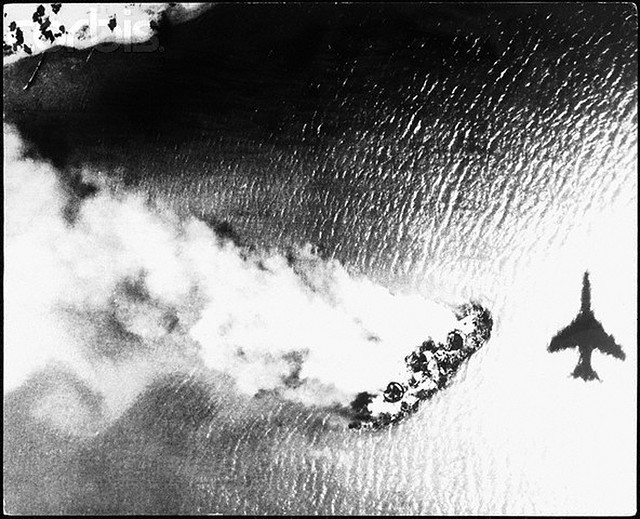
On another occasion, involving VA-25, it involved PT Boats. I was looking for a ferry that was supposedly in an inlet a little north of Dong Hoi. Again, below 100 feet, and as fast as it would go. Taking fire from various sites, and happened to notice, for some reason that this rock was leaving a wake. Also firing at me. Ah Ha! PT boat! Found a couple of aircraft, and they managed to kill a few fish. This was in 1965. PT boats were instant targets. Went back to the boat, and CAG put together a full strike. Goes back up there. Goes trolling. As near as we could tell, at least 7 "rocks" got underway. They would just sit there in the middle of the inlet, wait for the A4's to release, and then move one way or the other. With 15-20 bombers dropping, we believe they managed to slow on down. Also increase the food supply with all the fish killed. Went back to the boat. CAG is really pissed now. So he sends 4 Spads late in the day loaded with napalm. One Spad would draw fire, and another Spad would make his run. Soaked down three PT boats, and left them burning hulks in the water. Willie is doing BDA on this one. Below 100 feet. We had a picture with the burning hulk of a PT boat with the shadow of an RF8 right next to it. What we didn't show was a few frames later with the same shadow with fuel streaming from the left wing. A 23 mm from another PT boat that was firing at him, goes in parallel to the wing, and blows the top and bottom of the wing off. A hole big enough for two people to crawl through. Broke the main spar, but it managed to stay together long enough for him to get to Danang. Willie was a three fifths black ace that deployment. --Scott Ruby
Photograph showing the shadow of Willie's RF-8G over the damaged Vietnamese PT boat. Courtesy of Jerry Fritze
(5/7/12 Scott adds this additional story involving VA-25: While we were in port, VA-25 came to Det ALFA, and asked if we would provide an aircraft to "attack" a division of Spads. It was my turn to fly so I became the agressor. Ed Greathouse was in the flight - I do not remember who the other ones were.
The basic rules were that I could attack from anywhere, and try to get a successful approach to them. The Spads basically were in a four-plane line abreast. We probably spent about an hour an a half out over the water.
I would make a run, and pull up into the sun and go back out 10-15 miles and come in from another angle - at various altitudes and airspeeds. I don't think I got within 2,000 feet before I was spotted. Then I was looking at four Spads - head on. I think the closest I ever got may have been within 2,000 feet - maybe. I was down to their altitude - or below - at better then 650 knots. I had set the radar altimeter to 100 feet and kept the light on. How low, I am not sure. But at 650 knots and below 100 feet, you do not put your head in the cockpit. Thet really had an excellent lookout doctrine going.
I left the det before the deployment was over. Went to PG school. My last deployment was on the Midway as OINC on the 1971 cruise. Everything worked on that cruise.--Scott Ruby
EMAIL RECEIVED ON THIS STORY: (5/6/12):I stumbled on to your site quite by accident looking for info about VA-25 in Nam especially in the run up to Khe Sanh and the Lang Vei Mission. I found this article below by Scott Ruby and would like to use it in an upcoming edition of our quarterly Fist of the Fleet Association Newletter (www.fistofthefleet.org)
of which I am the Editor.
[Webmaster's Note:] Scott Ruby approved the use of this and the July 2012 issue of the Fist Newsletter will include this story with a few new details provided by Scott. When I receive it, I'll post it here.]
(7/16/12)--Adobe(.pdf format) 1 MB copy of: VA-25 July 2012 "Fist of the Fleet" Newsletter--Scott's story is reproduced in this newsletter. Contributed by: Jerry Fritze, editor
Photo Missions and Their Fighter Escorts ..."hats off to the photo guys that few wanted to chase."
[The following from a Flight Schedule Officer from a fighter escort squadron:] ..."The mission no one wanted..PHOTO ESCORT. I caught so much crap from my sqd mates when I scheduled this
mission! I remember the reason no one wanted it was ... the photo bird was faster, was unarmed , had more gas, mission areas were very hostile, the escort was in trail (IE the Target), and always was getting shot at.
Although an exciting mission it was dicy for the escort. I always briefed my Photo guy: "If we get jumped fly like you are armed". Never got jumped but the stories I have heard they did!! Bottom line, there is more to this sorry but hats off to the photo guys that few wanted to chase. I never was a Photo Beanie but I look back & now say, you were the best. ----Bill B.
...It was the photo bird that was the target. The escort was stepped up, offset, and always jinking - out of harm's way. The photo bird on the other hand was in the thick of it,
over the target, straight and level at 1000 to 3000 ft. AGL.
In VN, VFP-63 suffered more combat losses than any other squadron. I suspect that the squadron also holds the record for more pilots turning in their wings because they didn't want to fly the mission. I don't believe a fighter escort was ever hit. It was my feeling that the escort was only there to tell my OinC where I had gone down.
The photo bird did not need MIG protection. If we ever got jumped (And we never did - they weren't going to waste their assets on a photo mission.), the escort would be a liability because he was slow, and more so, because he would probably turn to tangle with the attackers.
A photo det had four pilots. Det LIMA on Hancock in 1965 & 1966 suffered one KIA, Tom Waltzer, and two shoot downs with good ejections, John Heilig and Len Eastman, both of whom survived capture and prison. Three pilots who were assigned to the det to replace Tom turned their wings in. Of the nine Naval Aviators assigned to det LIMA, only three were on Hancock when it turned east for San Fran after our last mission -- the first strike on the Haiphong oil facilities in June 1966.
[call name]Rocky Squirrel
1966 - lost all oil in Haiphong harbor at 50ft and 600+ knots. Didn't realize till engine light illuminated - the oil pressure gage was a peanut gage. Set RPM at 86% and headed for Hancock expecting to eject somewhere en route. The engine ran for 40 minutes and got me aboard before the bearings fuzed on shut down. If interested, see full story in Ron Knot's book - "How I came to love the J57."
Since I am writing - thanks for all the hard work done by organizers of Pensacola event. Great to see some old Hancock photo escort buddies who watched out for this inexperienced young lad who tended to do dumb things in -66 and -67.
Len Johnson - "Rocky the flying squirrel"
Thank you for visiting our site.
Please Recommend Us To Your Friends
Email the Webmaster
We invite you to click this link - VFP-62 Webmaster to email a question, comment, correction, or contribution to this page.