


|

|

|

|

|

|

|

|
 |
 |
 |
 |
 |
 |
 |
 |
VFP-62 VIETNAM OPERATIONS(Including VFP-63) |

.jpg)
 |
 |

Taken from the Operation Electronics Div TACAN space aboard FDR CVA-42: VFP-62 operations in Vietnam 1966-67. This aircraft was lost with Lt j.g. Norm Bundy on Sept. 6, 1966. See ** for more information.
Photo Jim Macino ETR2 (click photo to enlarge)
VFP-62 and the Vietnam War
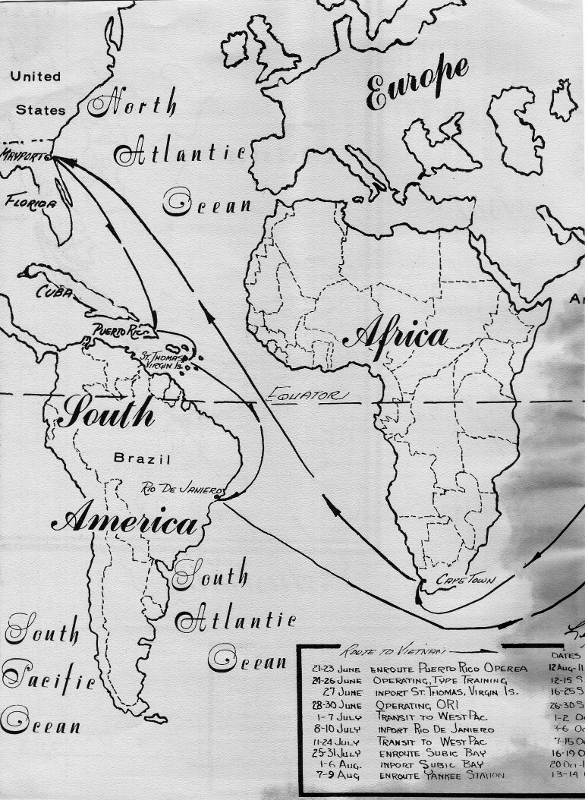
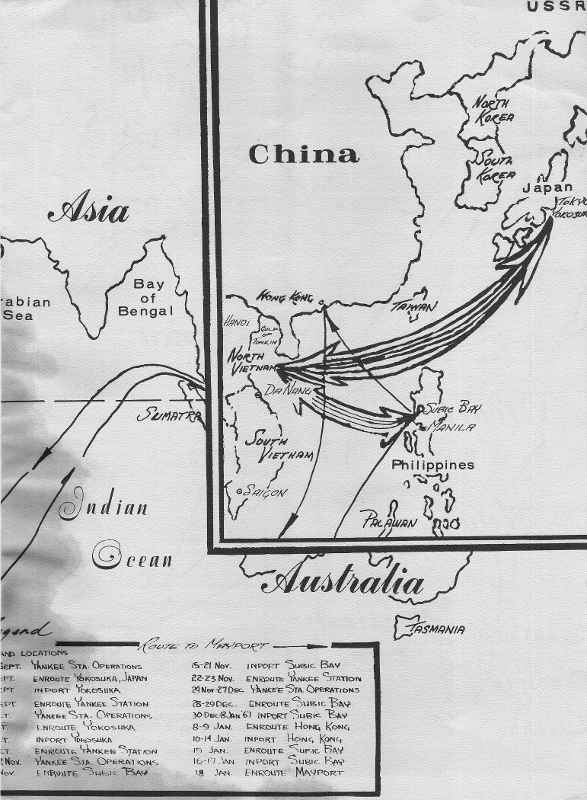
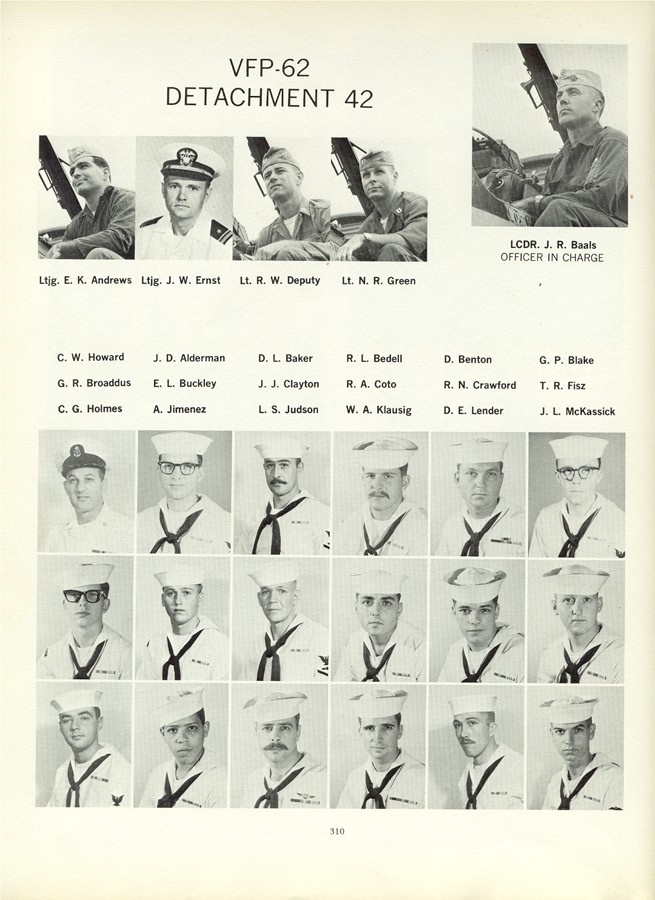
VFP-62 made one detatchment aboard the U.S.S. Roosevelt to Vietnam (June 21, 1966 to February 21, 1967). The pilots were John Baals (O-in-C), Norm Green (pilot of the damaged plane below), Ed Andrews. R. W. Deputy, and Norm Bundy (Killed in Action - see "In Memoriam").
**(11/13/14) [Webmaster: The following from Cdr. Norm Green gives more information on the above photo.] "Close inspection of the photo reveals that the aircraft has flown 25 combat missions when the picture was taken; it was pretty busy since we had only flown missions on about 23 days at that point. Using Russian math and some guesswork I would guess that the picture was taken on perhaps the 4th or the 5th of Sept, I flew that aircraft both Days. At first I thought that it might have been the 6th of Sept, the day Norm Bundy crashed in that aircraft; but I doubt that because of the light ripples in the water. There was no wind on the 6th of Sept, the Gulf of Tonkin was as smooth as glass. I remember that the cat officers could only give us 5-6 knots above stall speed that day. The Rosy had all boilers on line and was pulling her guts out. Amazing, sometimes I struggle to remember my street number but remember things from 48 years ago.
Click for: VFP-62 Vietnam Detachment Photos--Contributed by John Glenn
Click to see: Family Gram Dec. 1966---From the USS Franklin D. Roosevelt (CVA-42)---Heading towards Yankee Station Vietnam
--Contributed by John GlennClick to see: FDR War Cruise NewsletterUpdated: 11/8/11---From the USS Franklin D. Roosevelt (CVA-42)---Newsletter February - March 1967
--Contributed by John Glenn
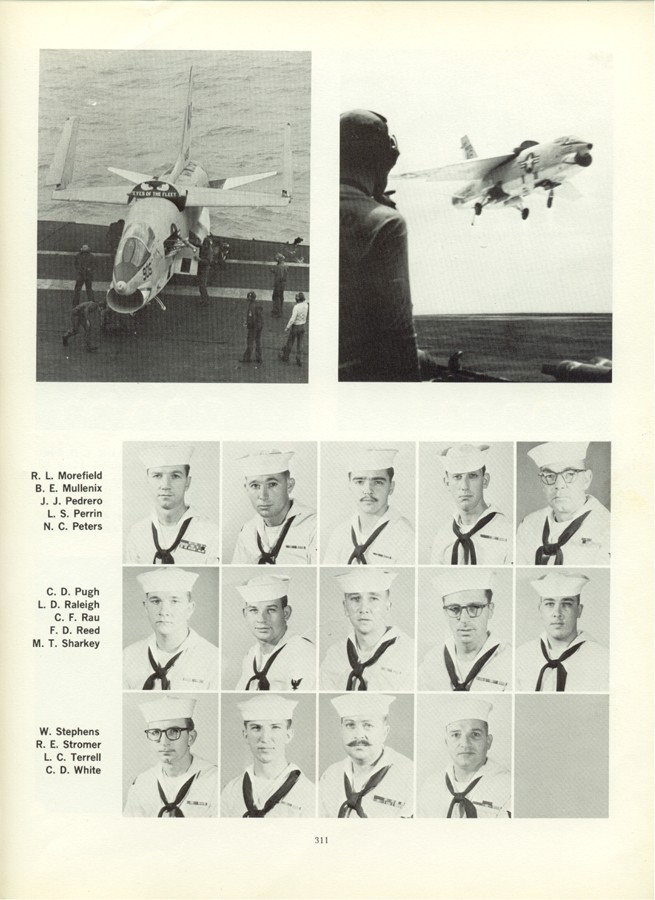
Above photos courtesy Ken Walling, webmaster www.vf32.info. "I was going to look on your CMC page, but clicked the Viet Nam site when I noticed a name I recognized, Ed "Hunyak" Andrews. Ed Andrews was our Maintance Officer with the Tomcats and I still have contact with him and we try to go out for dinner if I'm in Virginia Beach area.
The Crusader at War
The plane in the following photos was eventually lost off the Kitty Hawk in August of 1980. It was with either VFP-306 or VFP-63.
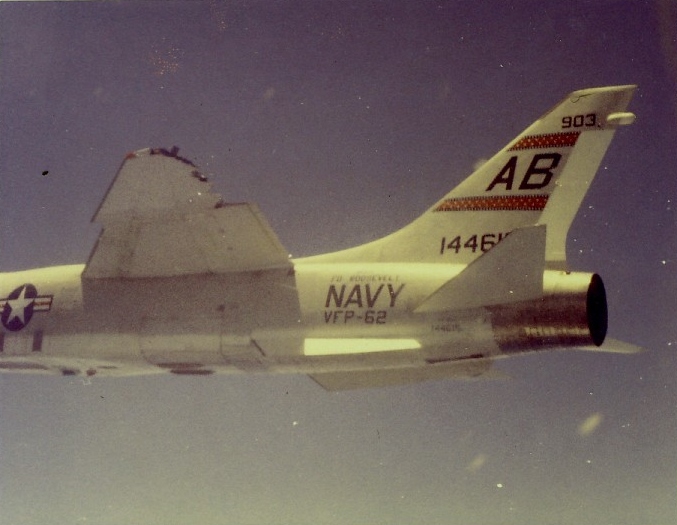
Air-to-air photo heading back to the USS Franklin D. Roosevelt (CVA-42). According to (then Lt.) Cdr. Norm Green pilot of the RF-8G, with typical fighter pilot humor: "the result of attempting to occupy same space as a well aimed 57mm round." Photo: Norm Green and does not enlarge.
The story behind the above photo: "One interesting note about the airborne shot of the damage--the picture was shot in 1966 by the RIO in the back seat of my F4B escort, I don't remember who it was. The pilot was Lt Marv Baker of VF-32; I spoke to him at a recent Crusader reunion and he could not remember who the RIO was. We do know that he used a very sophisticated camera known as a Kodak Instamatic; the one with the little drop-in cartridges. I don't think the Roosevelt was able to process the film so he had them developed during our next in-port visit. A few weeks later he gave me a couple of the prints; they were probably about 3" X 4". The prints were eventually lost among hundreds of other 60's era snapshots, survived many moves and years of less than desireable storage conditions in attics, basements and closets. They resurfaced about 4 years ago somewhat the worse from age, well over 40 years after their birth. I scanned them into the computer, did the best I could to clean them up and improve the color and -VOILA- the wonders of science and computers!" Best regards, Norm Green
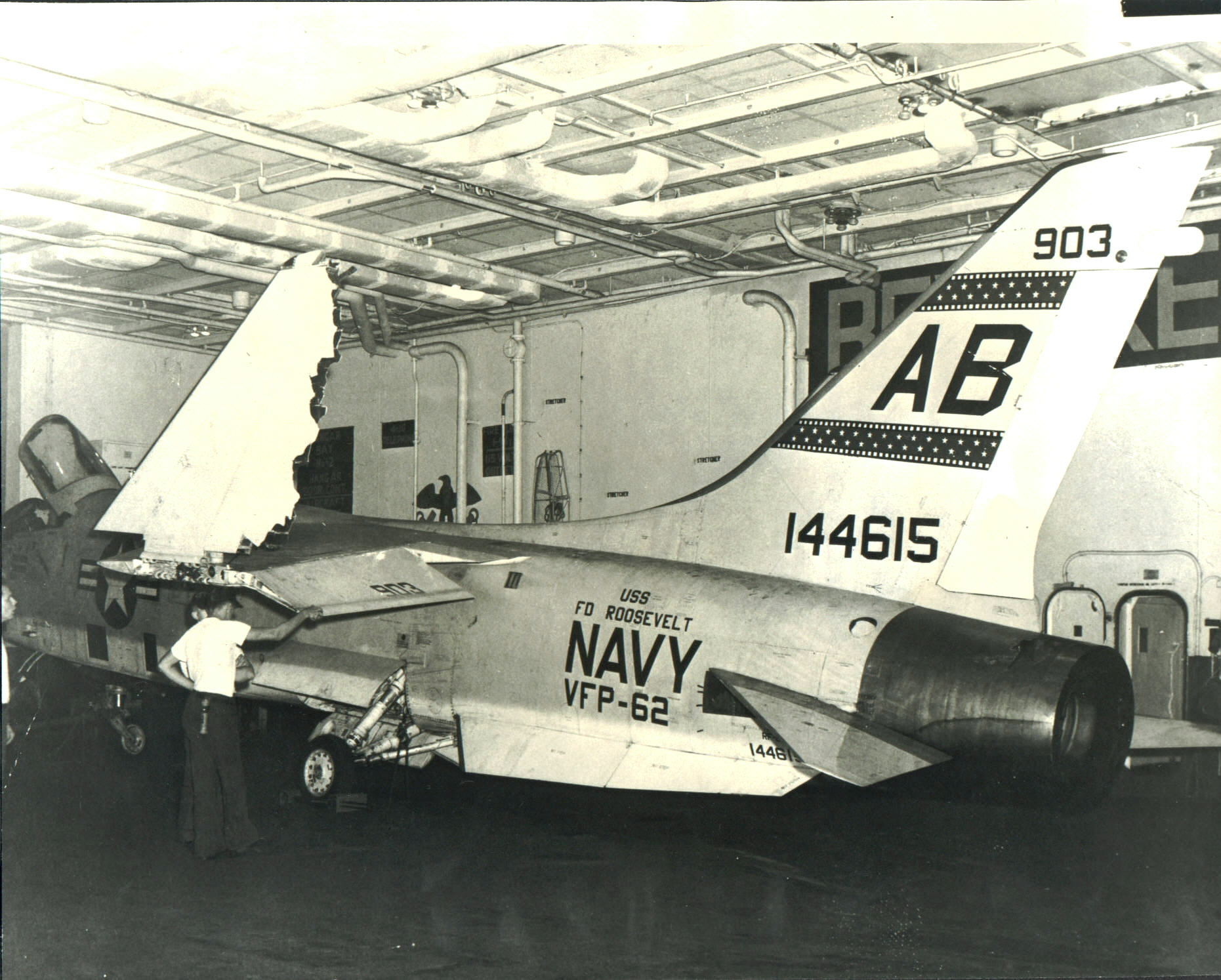
Damaged wing by North Vietnamese 57mm shell during a reconnaissance run. It is a testament to the ruggedness of the RF-8G Crusader and skill of the pilot (then Lt) Norm Green).
Click to enlarge -- Photo courtesy: A.W.Scarborough, PHC (Ret)
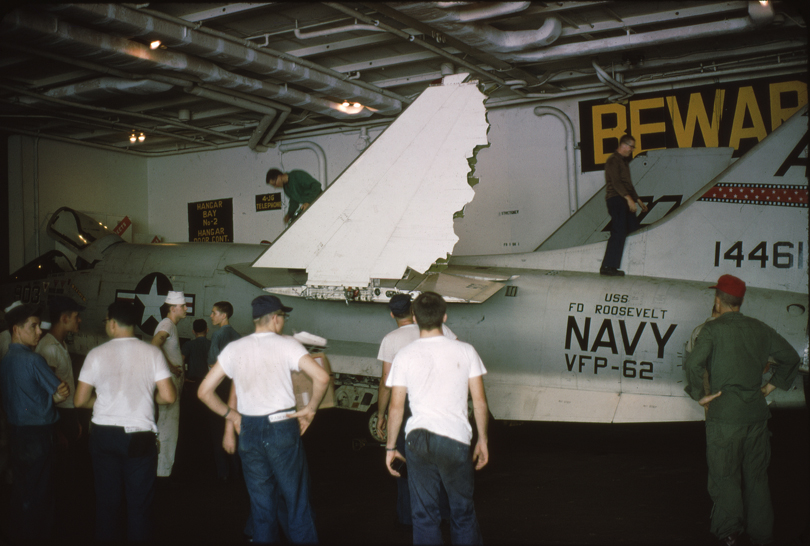
Photo Courtesy: Jim Macino (former ETR2 USS Franklin D. Roosevelt -- webmaster ussfranklindroosevelt.com)
Video of the above damaged RF-8G--Courtesy of Larry Blumenthal
Click to see video: VFP-62 RF-8G battle damage video
Click to enlarge -- Photo courtesy: A.W.Scarborough, PHC (Ret)
Video of the above damaged RF-8G--Courtesy of Larry Blumenthal
Surface-to-Air Missile (SA-2) Detonation off wing of VFP-62 RF-8G
Photo Contribution: Cdr. Norm Green, VFP-62 pilot

The story behind the photo: The photo is an SA-2 detonation that missed Ensign Ed Andrews [see "In Memoriam"] and me after some hard maneuvering.
We were running along a karst ridge northwest of Thanh Hoa, ECM [electronic countermeasures] lights up and about 15 miles at our 9:00 o'clock an SA-2 [Russian surface-to-air missile] lifts, climbs to 5K, tilts over and tracks us.
We push the power up and turn into the SAM. Waiting for the appropriate time to make our break, he transmits-"Uh lead, check our 3 o'clock"; another SA-2 also has us boresighted. Afterburner now, hard right break, go for the deck, we successfully evade both.
In the excitement, Ed loses me and is gripping the power lever so hard that for the next 30-40 seconds the only thing that can be heard over the radio is his deep, raspy breathing [he jammed the transmit button]; it sounds like he has been hit. But all is well---we were just glad to be still flying---and we make it back to mother Rosie [USS Roosevelt CVA-42].--Cdr. Norm Green
- SYNOPSIS: The Chance Vought F8 "Crusader" saw action early in U.S. involvement in Southeast Asia. Its fighter models participated both in the first Gulf of Tonkin reprisal in August 1964 and in the myriad attacks against North Vietnam during Operation Rolling Thunder. The Crusader was used exclusively by the Navy and Marine air wings (although there is one U.S. Air Force pilot reported shot down in an F8) and represented half or more of the carrier fighters in the Gulf of Tonkin during the first four years of the war. The aircraft was credited with nearly 53% of MiG kills in Vietnam.
- Between 1964 to 1972, eighty-three Crusaders were either lost or destroyed by enemy fire. Another 109 required major rebuilding.
- 145 Crusader pilots were recovered; 57 were not. Twenty of these pilots were captured and released. The other 43 remained missing at the end of the war.
- According to Chris Hobson's "Vietnam Air Losses": "Total number of Navy RF-8 (photo Crusader) aircraft lost: 31. Fatalities: 12. POW's: 6. Aircraft lost by year: 1964: 2. 1965: 8. 1966: 7. 1967: 3. 1968: 4. 1969: 2. 1970: 1. 1971: 0. 1972: 4. Marine RF8 loss (1965): 1. --Contributed by Mofak
- VFP-63 pilot, Scott Ruby, adds: "The so-called official record lists 20 RF-8's as lost to combat. Plaques for 12 RF-8 drivers that did not return are on display at the Miramar golf course. However, that number is in some degree of debate. Another list I had access to lists 32 RF-8's as lost in the conflict."
- VFP-62's Lt.jg Norm Bundy was lost on Sept. 6, 1966 (More information below and "In Memoriam."
The most frequently used fighter versions of the Crusader in Vietnam were the C, D, and E models although the H and J were also used. The Charlie carried only Sidewinders on fuselage racks, and were assigned such missions as CAP (Combat Air Patrol), flying at higher altitudes. The Echo model had a heavier reinforced wing able to carry extra Sidewinders or bombs, and were used to attack ground targets, giving it increased vulnerability. The Echo version launched with less fuel, to accommodate the larger bomb store, and frequently arrived back at ship low on fuel. The RF-8A models were equipped for photo reconnaissance. The RF-G were also photographic versions, but with additional cameras and navigational equipment.--(Contributed by former Navy LT Hank Miller, VA-152 Spad driver USS Oriskany 1966-67-68.)
The combat attrition rate of the Crusader was comparable to similar fighters.
Capt. Jerry Coffee, Prisoner of War
(Feb. 3, 1966 to Feb. 12, 1973)
Cdr. Coffee and his RIO (Lt. Robert Hanson) in a RVAH-13 RA-5C photo Vigilante
were hit by AAA over North Vietnam
[(3/5/13) Webmaster's Note: Capt. Jerry Coffee was a Lieutenant when I arrived at VFP-62 in April 1960. On October 23, 1962, during the Cuban Missile Crisis, he made one of the first six low-level reconnaissance missions over Cuban missile sites. He wrote a story about his mission on October 25, finding the first evidence of tactical nuclear weapons in Cuba (See it on our "Cuban Missile Crisis" page: The Photos That Averted World War III.) For more information on his shoot-down, Click on: Event Report] Click to see a video of: Capt. Coffee's Motivational Speech YouTube video on his motivational speech. He was the featured speaker at a convention I attended in Hawaii years ago it was very inspiring. --Pete Wallace
Click to go to Top of Page
Click this link to get (.pdf file) a first-hand account of the first jet (VFP-63 RF-8G) shot down in the war.
RF-8 pilot Chuck Klusmann's rivoting account of his shoot down, capture, and escape. Rear fuselage of a photo Crusader with "VFP-6" showing:-F8U-1P (RF-8) Wreckage in China - It is conceivable that wreckage of photo Cruaders were brought to China from Vietnam for intelligence gathering. Click to see the photos and text from the photographer Howard Shen.
(update 1/13/16)) Click to read: WAR STORIES--Photo Missions and Rescues Over Vietnam -Accounts of the RF-8 in war.
 (6/27/2024)
A VFP-63 Sailor's Memories of a War Cruise
by William Beiriger PH2
The USS Oriskany (CVA-34) Fire
October 26, 1966
144 killed; 156 injured
Webmaster: William Beiriger was a photomate with VFP-63's detachment aboard the Oriskany during it's war cruise to Vietnam.
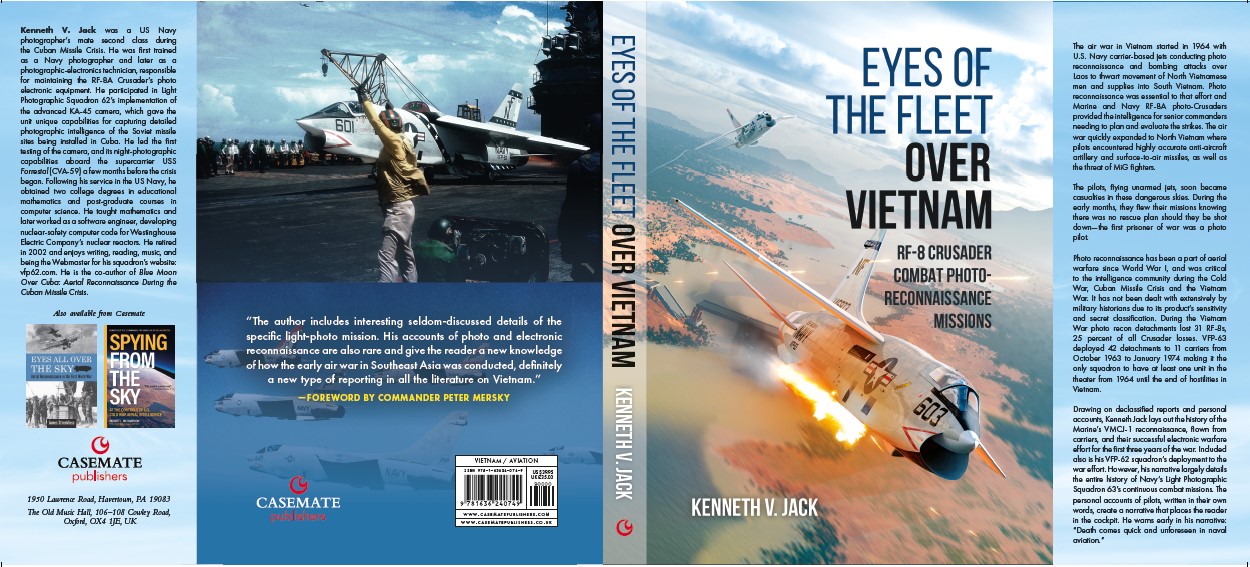
In the text, he refers to my book Eyes of the Fleet Over Vietnam and gives his eye-witness account of the devasting fire.
I enjoyed your book very much, even though much of the info is sad. I still watch some of the old military type TV shows. But I will not go to see movies because I don't like seeing these big movie companies making millions of dollars on the loss of military members lives
I was thinking about several stories with VFP-63. I remember many of the pilots that are in your book, and the memorial stories for them. It's very sad to find out how many of them were shot down or had aircraft problems and crashed.
The original Officer-In-Charge of the VFP-63 Detachment was LCDR Thomas Tucker. He was shot down on 31 August 1966, over Haiphong Harbor and rescued. He was a Fighter Pilot in Korea before becoming a pilot with VFP-63. I had a chance to visit with him at The Naval Post Graduate School in Monterey, California.
While on detachment to Vietnam, one of our pilots took up a RF-8 that had just been repainted after having some moderate damage repaired from being hit; the plane was given a new paint job. After he returned to the ship, a lot of the paint on the leading edge of the wings was peeled off. We asked him how fast he was flying, he said, "0.98 Mach." We then asked him what altitude he was at, he wouldn't say. We think he was just above the waves.
I almost had a jet blast turn on me and I had to take to the bronze safety net along the flight deck. It was very hard when I hit it, but it's better than going into the water. I know of one deck person being sucked into an intake, the jet was at idle. Two other individuals pulled him out, his face was very red, but he totally recovered. Another individual walked into the prop of an A-1; he died on the flight deck. We had a photo mate that was so scared of the flight deck that we wouldn't let him on the deck; he may have gotten himself or someone else killed.
After our planes dropped the arresting gear, we would start walking alongside, while the plane was still moving, and start to unbutton the camera bays to recover the film and take it to the processing lab for a rapid turn-a-round.
There was an officer from another squadron or ships company, that had just finished his career, he got on the COD [propeler transport plane] to go to a base so he could go home. As the COD took off the seat that he was in came loose, if I remember, he had so much damage to his legs that I think he lost both. They cleared the flight deck so that the COD could return.
The Oriskany pilots cross-decked with a British carrier, I think it was the HMS Victorious or the HMS Invincible. I don't remember but I think the pilots from the Oriskany just did touch-and-goes. There is no mention of the Cross-Decking in the cruise book. But I met up with several of the enlisted crew off the British ship and went aboard for their Rum Ration down in their mess (also their sleeping area). It was only four years after that that they did away with the Rum Ration. After we had Rum, they came aboard the Oriskany and couldn't believe how big she was, because the British ship was much shorter than the Oriskany.
When I was aboard the Oriskany we had, SOD MacNamara, Arthur Godfrey, John Gavin. We also had one of the officials from the Eastern Sun Shipping Company, that owned the SS August Moon, come aboard and give a trophy of thanks for saving the 44 members from their ship. That number was the same as the number we lost on the Oriskany fire. At the time of the fire, we had a news crew from either Life Magazine or one of the other magazine companies.
Our working and sleeping area were one and the same. If I remember there were 5 racks that were folded up most of the time. We were on a half deck just below the number three arresting gear, so it was very noisy. Most of the time we worked 18 to 20-hour days. Because of the humidity and heat, I found the best place to catch a short nap was on the wing of one of our planes, while it was on the hangar deck. When it was time for it to be taken topside, they would wake me up and take it up.
During the fire aboard the Oriskany I had my camera and was taking some very good photos. About an hour after the fire started, a ships company officer came up to me and took the camera and two rolls of film, and I was told I was not a ships company photographer. I never saw the film again, but after we pulled into Subic, I was given back my camera.
After the fire, we started for home, one of the pilots from VFP-63, decided to play officer with power over the enlisted men in the group. Ships company gave all the enlisted personnel jobs to keep us busy, so we wouldn't think about what happened because of the fire. We even chipped paint and other jobs like that. Our one greater-than-thou officer had some of us cleaning their stateroom, we finished it and he put on white gloves and ran his fingers down the joint between two plates in the bulkhead; he got his fingers blacked, and started to have us re-do the cleaning. At that time one of the other officers came in and the officer that was going to have us reclean the space was told, we all went through a lot of hard times, after the fire. At that point our cleaning job was finished, and we returned to our assigned areas.
Another officer I missed after the fire was, LCDR William Garrity, the Catholic Chaplin, I served Mass for him several times, and spent time talking photography, and had a chance to look over some of the special photographic equipment he had purchased. His stateroom was untouched by the fire but he died of smoke inhalation. The Protestant Chaplin, LCDR Perry, was just coming back off emergency leave and was on one of the other carriers. His stateroom was totally destroyed by the fire except where a Cross was hanging on the bulkhead.
On the way back to San Diego, I was the only member of VFP-63 that still had a beard. The rest of my group wanted to take a chunk out of it so I would have to cut it off. I was lucky, I had access to the photo interpretation area, so that's where I would stay to get some rest. I did get back with my full beard.
I have a 35mm slide of the Russian Bear aircraft being escorted by planes off the Oriskany. If I remember he stayed with us for about three days.
I remember a RA-5C flying into NAS Miramar one evening. He turned on the Photo Strobes Pods, I think he had them on both wings of the aircraft. They cycled from Left to Right and front to back and lit up perfect squares on the ground. I also remember that the cameras were in a pod system under the plane. The plane was brought to the photo line area of VFP-63. They had a special security team keep watch on the plane, but the personel from VFP-63 weren't allowed near the plane. If I remember, there was some classified equipment onboard. We never had a chance to see it close-up.
I remember a story that dates before I got to Miramar. It was during the Cuba incident, they gave 45's to the security guards for each of the squadrons. One of the Sea Fad Duty Officers was driving down the slow speed taxiway, the security guard blew his whistle, and told him to stop, He just kept going. The security guard pulled out the 45 and shot through the rear window of the pick-up. That night they went around to all the squadrons and picked up all the 45s from all the guards and told them they didn't want anyone to get killed. The next day they chewed out the security guard, that fired his gun, for missing the driver, so much for life.

Off-loading Bodies at Subic Point

Burial at Sea

Blessing the Dead
-
A note about the above photos: I think the Protestant Chaplin is the one on the right of both photos, the shorter of the two officers. He is LT. CDR. Perry. The taller one is most likely the Catholic Chaplin from the base at Cubi Point. In the photo he has his Vestment's on.
VFP-63 and the Vietnam War
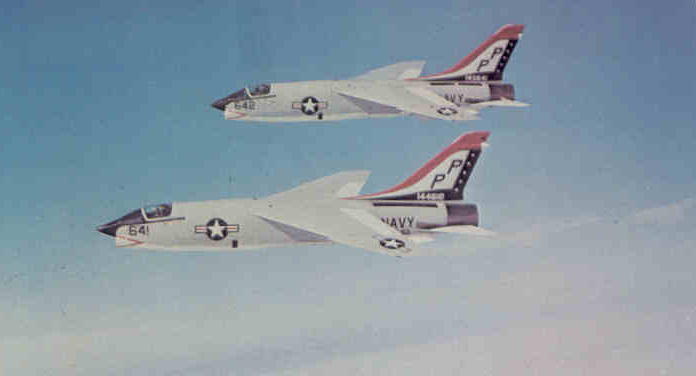
Our sister squadron, VFP-63 the west-coast photo squadron, had the major burden of the Vietnam War. As they lost planes, VFP-62 was used for plane replacements, which eventually led to its dis-establishment in 1968.
Addendum
Webmaster: William would appreciate information on: two questions:
1 Not long ago I was told that the 1966 cruise of the Oriskany received the Navy Unit Commendation, for the Ships Company and the Airwing. Who do I contact?
2 My wife had a cousin, LT John Norman Stanley, from California. He was a pilot that was killed on one of the carriers during the Vietnam War, on September 28, 1963. He was killed by a cold-cat launch or a bad ejection from a plane. The only record of him being in the Navy is his burial at Fort Rosecrans National Cemetery. I have been looking on the internet about all types of pilots dying from aircraft accidents and I can't find anything. Again, who can I contact? [Respond to the Webmaster]
Click to go to Top of Page
(9/9/14) Vietnam War Casualties on the Vietnam Virtual Wall---Selections can be made state-by-state, photographs, units and more.---Contributed by Greg Engler & Adam Miklovis
I hope that everyone who receives this appreciates what those who served in Vietnam sacrificed for our country.
The link provides a virtual wall of all those lost during the Vietnam war with the names, bio's and other information on our lost heroes. Those who remember that timeframe, or perhaps lost friends or family can look them up on this site.Texas Tech Univ's Vietnam Center Best comprehensive online research library of Vietnam material in the world.
[Webmaster's Note: This huge website is the creation of Tom Pilsch, former Air Force Forward Air Controller (FAC). You will find an extensive history of the Vietnam War.]
Click here: Best search list ever compiled about the Vietnam War.
(3/25/13)Gentlemen,
While surfing the Web today, I came across your great site and especially appreciated your recognition of my Vietnam War Websources* page as "Best search list ever compiled about the Vietnam War." I very much appreciate the honor.
I really enjoyed your site. I have been a fan of the Crusader since it first flew -- a beautiful airplane -- and your stories and photos were great.
I have added two links to your site, one on the saga of LT Klusmann and the other to your war stories. In doing this I realized my Air Force bias had unintentionally shown through -- I have little on the page about naval air ops in SEA. I have begun to rectify that. This is embarrassing since one of my all-time favorite war flix is "The Bridges at Toko-Ri" since it first came out!
To you and all of your members: thank you for your service and for your efforts to preserve the history of what we did in Southeast Asia, and
Welcome Home!
Tom Pilsch Trail 32, Hue '68-'69
[Click to see: Tom's Home Page--What does a FAC protect himself with? That and more.]
EXTERNAL Records of Vietnam War Information on the Marine Corps