Crusader Accidents and Other Mishaps The Danger of Flying and Working on the Crusader
Updated January 25, 2025 (Look for flashing "New" below)
A narrow escape from a sinking F8
After a faulty starboard cat launch aboard the U.S.S. Shangri La, Commander J. E. Davis from VF-62, fights to escape his F8 after plunging into the sea. Owing to a failure in the linkage between the aircraft and the catapult, the fighter veered to the starboard side. The Crusader's wheel rolled over towards the gun mounting and plunged tail-first into the sea. The pilot escaped with a cut elbow.
Webmasters message: Naval Aviation is a dangerous occupation. The following is a collection of tales of bravery, dumb luck, tragedy, and survival. Freedom doesn't come cheap! This page is dedicated to those who paid the price for freedom.
The Crusader---A Dangerous Fighter to Fly History of Crusader Ejections and Other Statistics
(5/29/15)Aircraft mishaps over the first five years of flying.
Those F8's were hell of a plane in the air but they kept us crash guys busy taking off and landing. Were you at Cecil when the guy took off with his wings still folded. He got up there and flew around, landed it, put his wings down and took off again. He told the tower it was a little heavy on the nose but flew ok. His buddies took a set of wings to a jeweler and altered them so the wings were folded and put them on his uniform. It was good when an incident turned out good, unfortunately not many did. ---Kenny Boles
VFP-62 Accidents
Lt. W. G. Offerman's Fatal Accident
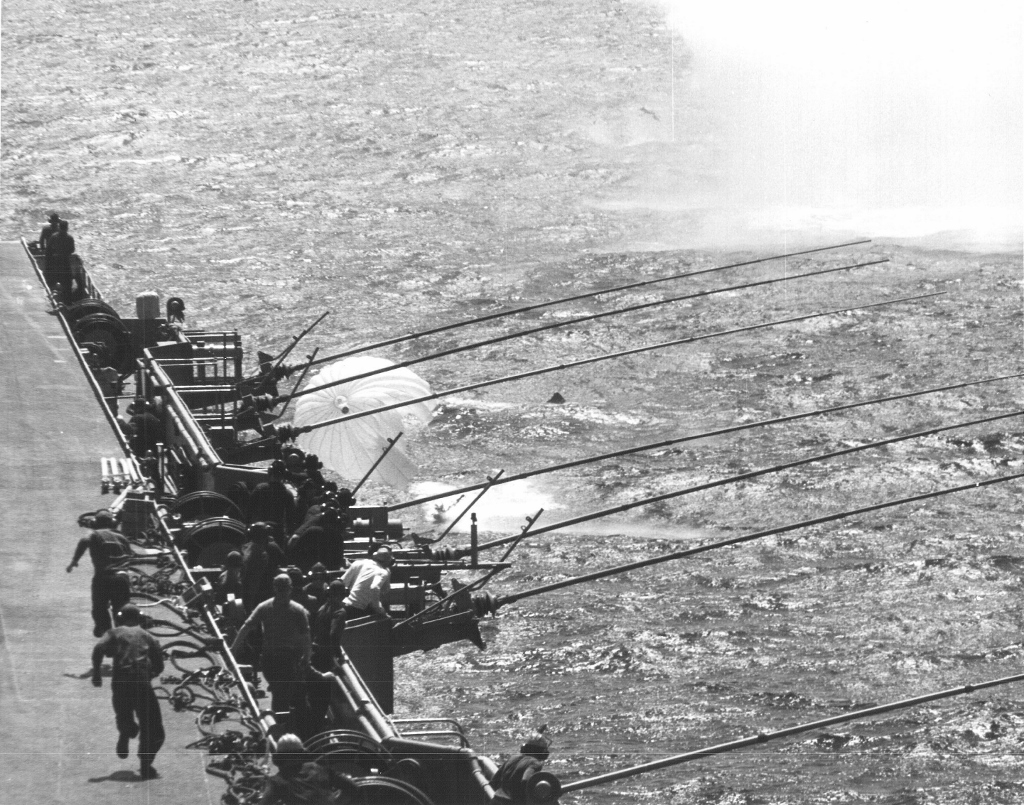
Lt.Offerman attached to his parachute. The RF-8's splash can be seen to the upper-right. Photos & Information Contributed by Capt. Phillip (P.J.) Smith
(7/10/13): On 22 May 1961 I was [USS Franklin D. Roosevelt CVA-42] Det 42 Maintenance Officer and as such was on the flightdeck monitoring the launch of RF-8A BuNo 146839 with Lt. Walter G. "Gary" Offerman as pilot.
New ejection seats with zero level and 120 knots capability had been incorporated. Gary and I had been reviewing the superior capability of the new ejection seats during the briefing.
On launch the right wing dropped to the deck as soon as cat tension was initiated. The aircraft continued in the wing down position and Gary ejected just off the bow. He was ejected away from the ship's bow when the 'chute blossomed and he swung maybe once before water entry.
From the deck I could see Gary grasping the risers. At the time something did not appear right. Later photos showed that Gary had somersaulted and the risers were then positioned between his legs. Consequently he could not reach the 'chute release mechanisms. The parachute was caught by the ship's wake and Gary was pulled under with the helo above him. In those days rescue personel were not put in the water when the ejection "SEEMED" NORMAL!" Take it from someone who knows---there are no "NORMAL EJECTIONS!" [Capt. Smith had two ejections.] The procedures were changed as recommended by the Accident Board: a crewman goes into the water immediately.
The movie coverage of the launch showed a mist under the wing at the landing gear location. I had gathered up the pieces of the failed strut. A closer look indicated that high temperature had occured. I forwarded the parts to the Naval Air Safety Center and later read that "dieseling" had occurred and caused the failure of the [landing gear] strut.
Strut servicing was changed from compressed air to Nitrogen, which seemed to correct that problem'
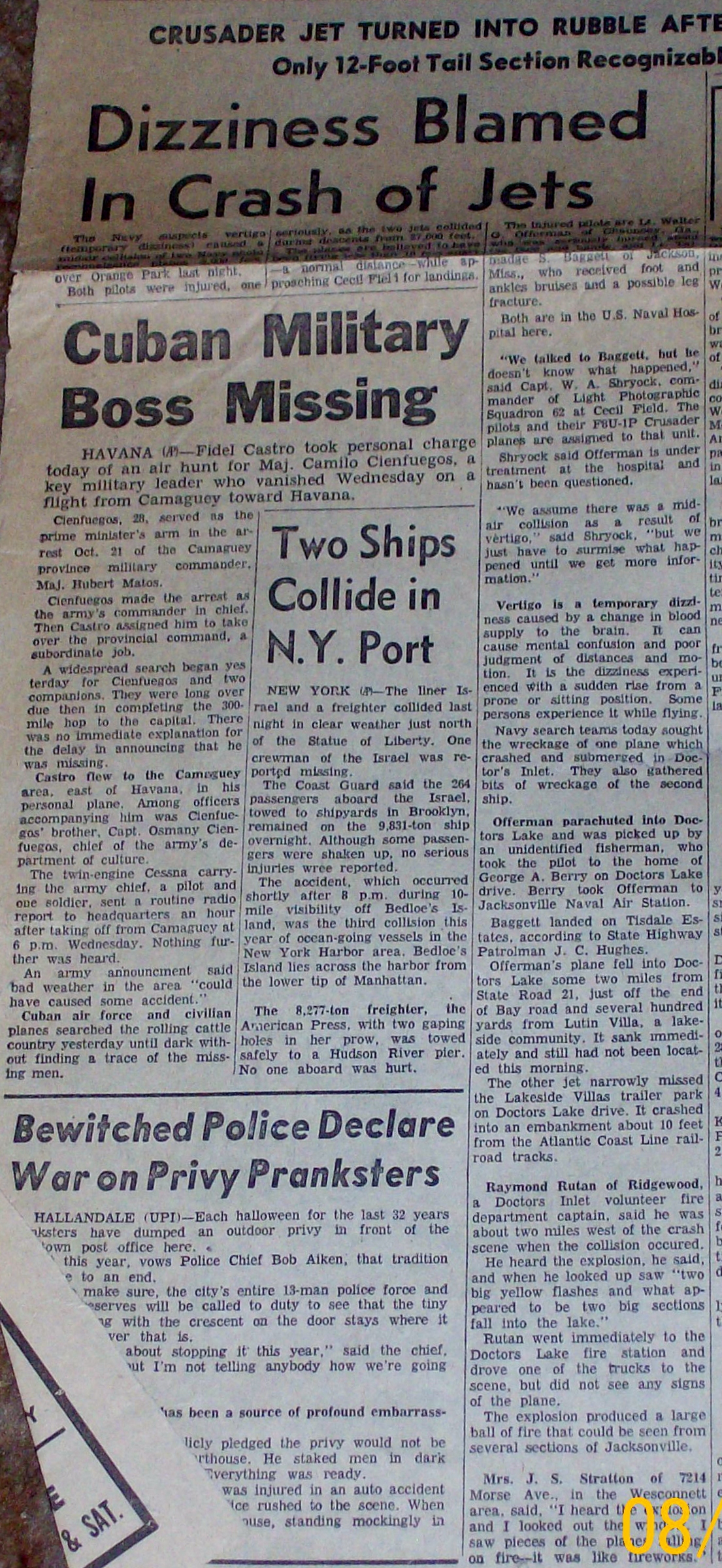
[Webmaster's Note: See Lt. Offerman's memorial page on "In Memoriam" and the account of his 1959 mid-air accident below.]
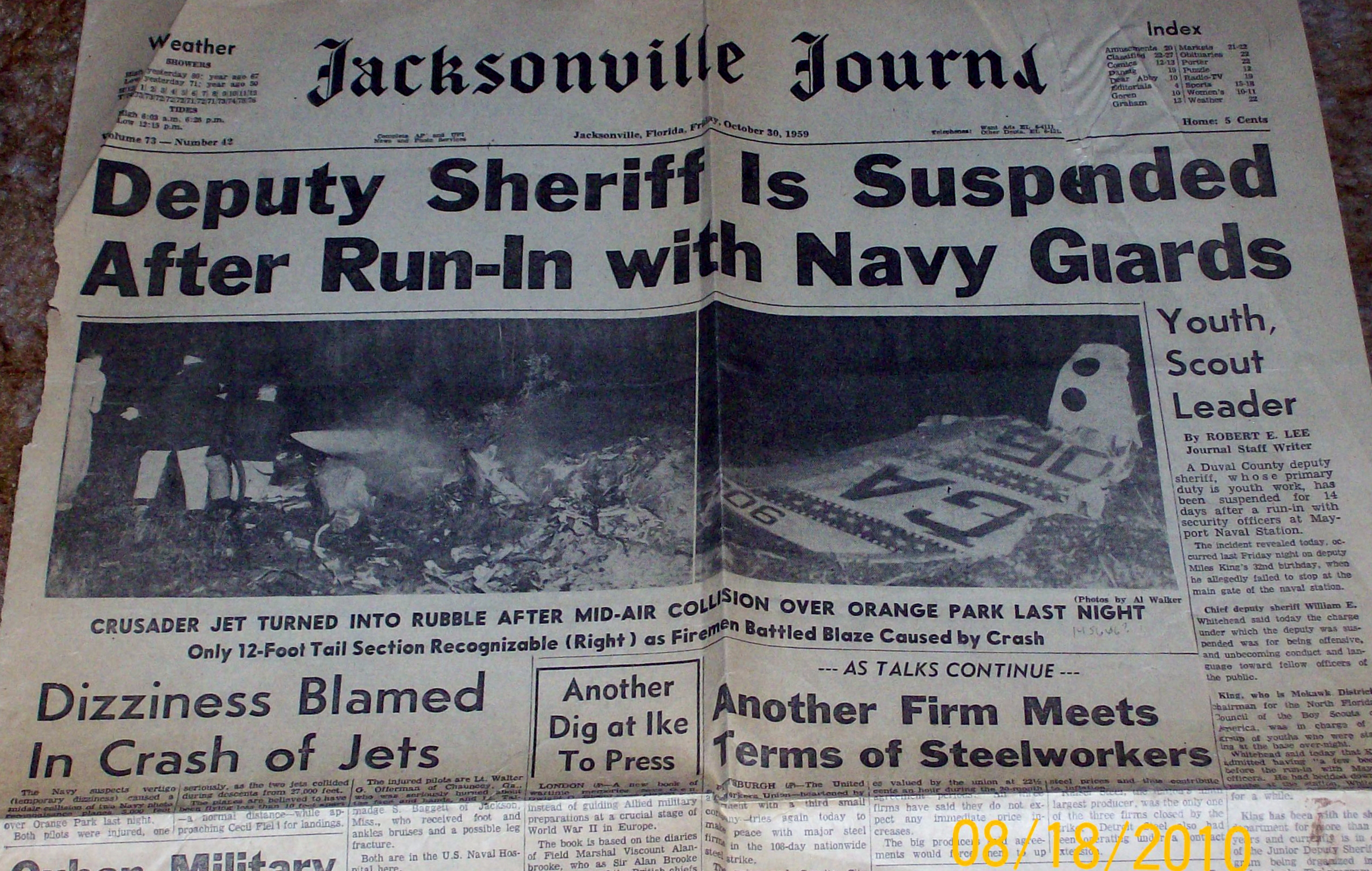
VFP-62 Crusaders Mid-Air Collision Orange Park, Florida
Contributed by John McKenna
(11/2/11): Click these links for more photos: Mid-Air Collision and News Article Photos can be enlarged in your browser window.
P2V-7 & RF-8A Mid-air Collision
27 SEP 67 A/C: P2V-7 [VP-30] Location: Jacksonville, Florida Beach Strike: Cause: Collided with a US Navy Jet CRUSADER (BuNo 146864 assigned to Light Photo Sq. 62, NAS Cecil Field, Jacksonville, Florida) collided over Jacksonville Beach, Florida on Sept 27, 1967....crashing on the swampy east bank of the Intracoastal Waterway. The Neptune was carrying two officers and three enlisted men....the pilot was the only occupant in the Crusader jet...a total of 6 people were killed. I was part of the aircrew on that aircraft earlier in that day ... and was asked to give up my position to let a fellow crewman get some needed flight time. I did so. It's been a sad experience to see so many friends lost that day Contributed by Andy Romanisky
Contributed to vfp62.com by John McKenna who found it in vpnavy.com
RF-8A Ejection Photos
Lt. Rod Rogers, a first tour photographic pilot with VFP-62 at NAS Cecil Field, had a chance in 1964 to film a live Crusader ejection, accomplished by Lt. Julian Baucom. To see the whole sequence and learn more about how the accident happened, follow the link*: Ever been in two aircraft accidents in one day? *[Webmaster's Note: The text and photos have been reproduced here by permission.]
Last VFP-62 Detachment on the USS Shangri La "Shooting the Russian Bear" and Ejecting Afterwards
It's probably not in the records, but we lost 2 planes before we even got to the Med. The first plane was lost just before deployment in a fatal mid air over Jacksonville. We received a replacement aircraft days before we deployed. It was an interesting aircraft in that it had just completed a major overhaul in Norfolk, and passed every test on its first, and only, test flight. We took delivery of the plane just after that flight. I flew the aircraft from Cecil to NAS Jax [Mayport] where all the planes were loaded on the carrier. During the loading, the crane operator managed to put the refueling probe of one of our planes through the tail of another, so we started the cruise with one operational jet, the miracle replacement that had less than 10 hours on it since major overhaul.
During the crossing, we experienced 10 foot sea states most of the voyage. The escorts we refueled were taking blue water over their bows while our band accompanied the refueling from the elevator on the hangar deck on our relatively stable platform. I was on the alert team, sitting behind the port cat when we got the signal to launch. An incoming aircraft had been picked up, and as expected, it turned out to be a Russian Bear intercepting the ship for reconnaissance. The two fighters sitting on the cats were launched with no problem, and the A-4 tanker moved up and was launched from the starboard cat. The flight deck crew couldn’t get the electrical power cart working on my plane (brand new equipment), so they towed me onto the port cat where the deck edge power, just used to start the fighter, failed. After several attempts, they towed my plane to the starboard cat, and we finally got the engine started. But then, they couldn’t get the wing locks out, so we had to shut down and bleed the hydraulic power. Once the locks were removed, we restarted, and I was ready to go. When the launch officer gave me the signal, I looked up and was staring at the Bear approaching head on at low level. As soon as I was airborne, I lit the burner, made a sharp left turn, then back to the right to join up on the bear. As I joined up on the Bear with the fighters in trail, I was slowing fast, engine at idle and speed brakes out. When I advanced the throttle, the engine experienced three rapid compressor stalls, but then came up to power. Those old J57s never stalled, so this was a bit unusual, but I checked all the instruments, reported the incident, and was directed to continue the mission (which was all I could do since there were a lot of planes parked in the landing area).
Then just as I was taking the mandatory shots of the Bear with the ship in the background, my oxygen failed (apparently the compressor stall broke the oxygen line). Again I was told to “continue the mission” but stay below 10,000 feet cabin altitude. Everything was going fine when flight control asked me to get some shots of the top and bottom of the Bear to check out antennas. I had the cameras on and began a slow barrel roll around the Bear. As I came across the bottom, I had the power back, and when I started the second time around I pushed the throttle up and the engine stalled hard just as I was over the top of the bear. The cockpit filled with smoke and the engine rolled back to idle. I immediately called “Mayday” and turned towards the ship with the fighters peeling off and escorting me.
The folks in CIC went a bit crazy, and called the captain to inform him that the “photo plane just collided with the Bear”. Fortunately they figured out the truth before they could radio back about our “international incident”. I popped open the emergency air scoop which caused a sudden decompression, but no ill effects. The engine wouldn’t respond to the throttle, but just caused more smoke when I pushed the throttle up.
As I headed towards the ship, the rescue copter was launched, and at 10,000 feet, I turned away from the ship and prepared to eject. Even though I knew there was no option, I didn’t bail out until I reached 5000 feet. The ejection sequence was not what I expected. I thought I would recognize all those individual events they drilled into us during training, and panicked a bit when all I felt was one big jolt. When I lowered the face curtain, I instinctively looked up and saw a beautiful chute. Then I looked down and saw my plane, minus the canopy with the seat rail sticking up from the cockpit.
I made it into the water just fine, and despite the high seas made it into my raft just in time to see the copter starting its hover overhead. I rolled out of the raft as they lowered the hook, but the first two times I reached for it, the hook jumped out of reach as the waves carried me downward. On the third attempt, they let out some extra line, and I got on the seat with no problem. And so, the first landing of the cruise was made by the copter bring me home.
Meanwhile, as the copter was headed my way, the LSO saw an F-8 making a right hand approach to the ship and ran for the platform, tripping over one of the wires as he hurried to bring the plane in. By the time he made it to the platform he saw the plane continue to turn past the line up, and realized it was my crippled jet. He watched it hit the water, and turned to look for the copter just in time to see me half way up on the hook.
All in all, not a good day for our detachment, especially for our replacement aircraft which still had less than 10 hours since overhaul. One of the fighter pilots reported seeing a clear stream of fluid, about an inch in diameter, coming from the coffin panel on the bottom of my plane. A fuel leak, cause unknown. It could have been the hard stall of the engine, or a maintenance problem during overhaul.
LT Gary Adams
Update (1/22/15): I was on the LSO platform when Gary Adams ejected. As I remember, there were three Bears that day. When Gary's problem came over the radio, and that he was going to have to eject, the Bears all disappeared over the horizon. When Gary ejected over the ship, the a/c continued to fly, in descending circles around the ship. The helo didn't dare go after him right away, because the F-8 kept coming close to where Gary was descending/swimming. When we saw the a/c finally splash down, maybe a mile from where Gary was, the helo went in and picked him up. As soon as he was on board the helo, the helo radioed that they had him & were inbound. Within minutes, the Bears came back, made another pass or two, and went home.
I was on a Badger intercept in the Med (Egyptian Badger's were doing the same thing Russian Bears did in the Atlantic). We carried hand-held 35mm cameras, Nikons I think, with 100mm lenses. I took a pic of one of our VF 13 a/c shadowing a Badger; about 30+ yrs later I saw that pic again, passed along by Martin Zjystra, a Dutch AF major doing research on CAG-8. He thought it was something I would be interested in; he was pretty surprised when I could tell him who took the pic, who was flying the "shadow", and when it was. -- Thanks to: Dave Johnson, F8 pilot
Update (5/29/15): Not a mishap but your mention of Dave " fireball " Johnson getting 35mm handheld shots of a Badger got the memories going and a question that I don't recall a answer to. I was with VF-13 on the next cruise and got the Badger call on the port cat. Played the usual games on the way in but I remember being surprised when he opened the bombay doors in close. As I was reporting this to CIC I dropped back and got a little up and got the winders growling. My request for instructions was met with "Wait one! " the "1" seemed more like 1001. They came back with " Do a visual of the bombay interior." We were pretty low and as expected he got lower when he saw me move up. I stayed pretty much at the intersection of wing and fuselage trying to keep some blue sky above. All cameras! some lenses had way bigger diameters than I had heard of. Got some handheld pics around somewhere.
That was the only flyover of the cruise. Bombay doors normal ?
John Mc$herry VF-13.
[Webmaster's Note: LT Adams' account is from the last VFP-62 detachment on the USS Shangri La, circa 1967. VFP-62 was dis-established on Jan. 5, 1968]
(7/29/14) YouTube video: Includes some good F-8/RF-8 videos---The Man Who Rode the Thunder--A Marine pilot ejects in a thunder storm. Good narration. ---via Robert Strong
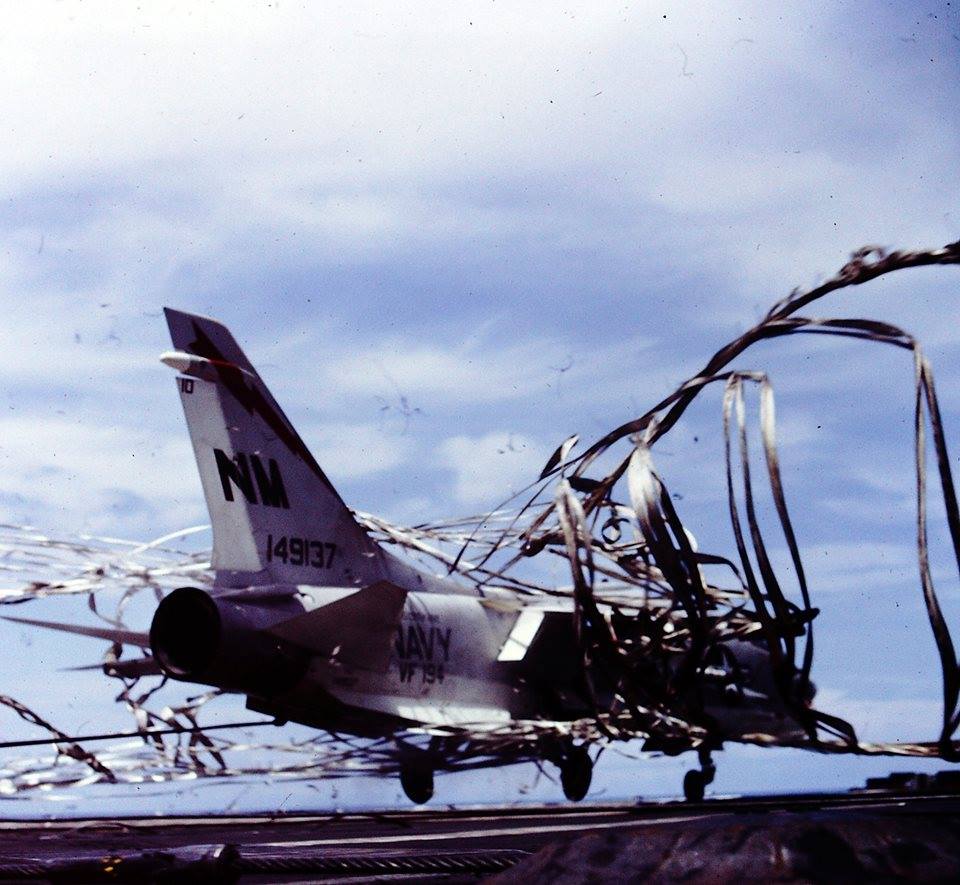
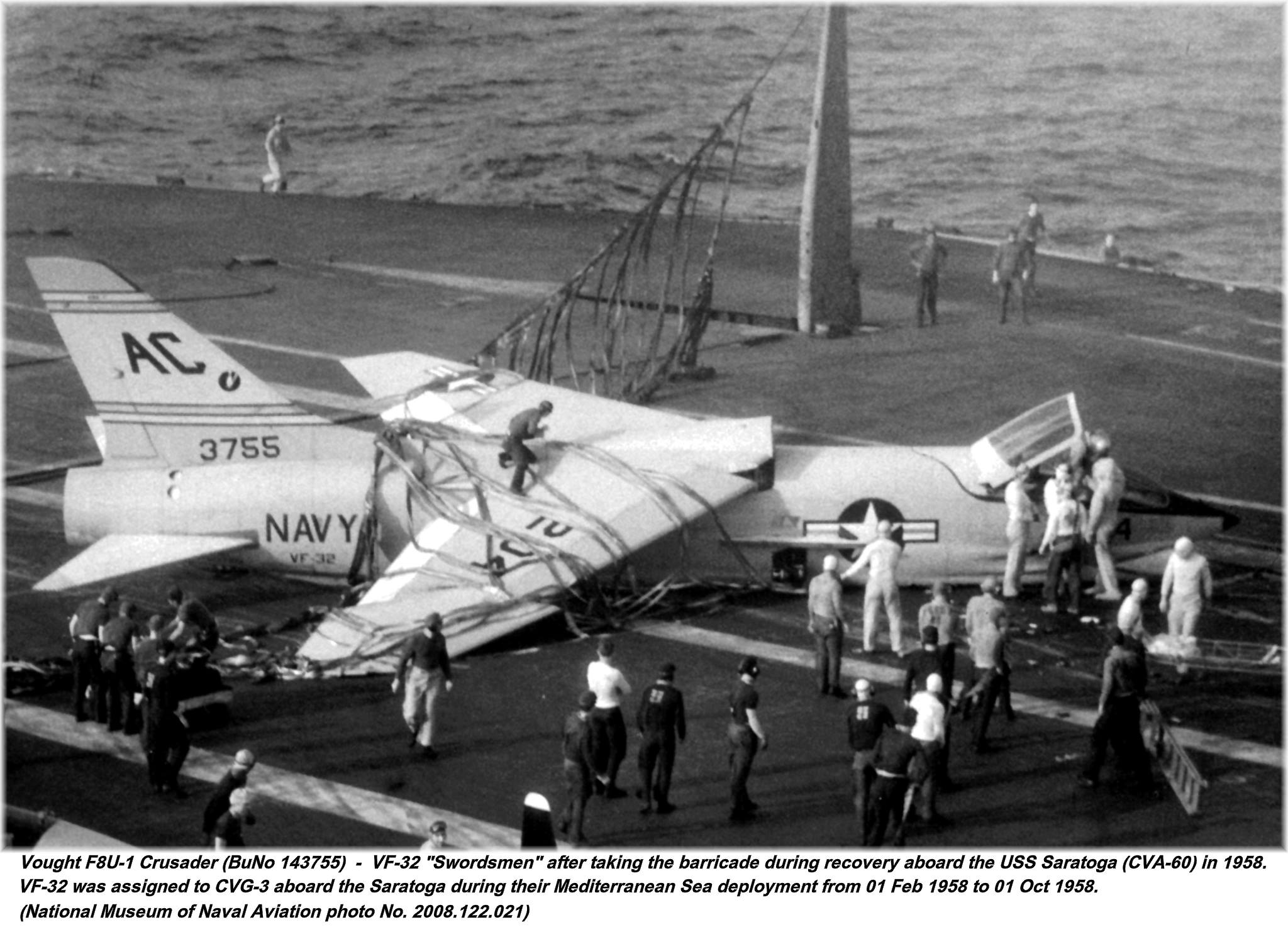
On Oct. 10th, 1962, on board the Bonnie Dick, CVA-31, a pitching deck off the coast of Hong Kong caused the left main wheel to separate & a bolter followed. All other A/C were recovered & the barricade erected.
Second pass was an OK 2 wire with the hook releasing the wire after about 30' of travel. Barricade cable did not release from the top of the stanchions allowing the A/C to "eat" it's way thru. The A/C left the angle deck with full power at about 100 kts. & hit the water flat. It broke into several pieces, wing, fuselage & cockpit. Canopy was gone so pilot proceeded to unbuckle the shoulder fittings. Cockpit then rolled inverted & sank. One Hartman fitting had broken, so mask had to be held in order to get oxygen. The two waist buckles were released, only to discover the left foot jammed under the rudder petal. Pilot stood on the seat & lunged, releasing foot, & also disconnecting O2 hose at a depth of about 40'.
Swimming to the surface he saw parts of the A/C sinking around him. The bridge had incorrectly called for full right rudder, throwing the stern toward the crash site, so the pilot also saw one of the huge props throwing bubbles as it churned past. Made it the surface after remembering to actuate the Mae West. Chopper was right there & deposited pilot on the flight deck. Slight injuries, cut on chin & elbow, flew two days later. [Source: F8 Crusader Organization]
(3/12/13: I took the barricade in F-8E BUNO 149222 February '68. I had 0 oil pressure for over an hour coming back from Haiphong, had the power set at 86% and had not touched it. Crossing the ramp the LSO, Dick "Tiny" Paschall, called for a little power, when I added it, the engine quit. I hit the barricade with the engine silent and no hook, but it stopped me. Probably better that the engine quit without a hook.
I have a friend named Barry Knunkel that went through an ejection in a F8. Seems he hit the ramp one night, and knew he was in trouble when all his lights went out. As he goes off the angle, he ejects. This was in the early days when the F8 did not have a zero-zero seat.
The F8 had knocked off the starboard main mount, and as the airplane skidded off the angle, the ejection profile tossed him to the right. Before he can get full seat separation, he lands on top of his skipper's F8 that is being taxied forward, just aft of the cockpit. About this time he gets full seat separation, and the main chute starts to deploy. The main chute is sucked down the intake of a second F8 that is being taxied forward behind the skipper's bird. He ends up straddled up against the intake like being crucified.
He broke so many bones, that he ended up in a full body cast for at least six months. The fact that the initial impact was on top of his skipper's airplane that absorbed the impact, probably saved his life.
To read the full account of the first combat jet to be shot down during the Vietnam War, go to "Vietnam Operations" and go to VFP-63 operations for Lt. Chuck Klusmann's story.
He was captured and placed in a Laotian POW camp, but had a daring escape.
During our first line period in 1965 off the Midway, one of our det[achment] pilots, Willie, got his trusty
RF8A shot up. We found some PT boats in an inlet called Quag Khe (sp?), north of Dong Hoi. At that
time, there were no altitude restrictions on flight over land. It was not uncommon for us to
penetrate at altitudes below 100 feet, and as fast as the trusty RF8 would go. Somewhere in excess
of 625 knots.
While photographing a burning hulk, he gets hit by a 23 mm from another PT boat. The
bullet goes in parallel to the wing. Hits the leading edge spar and takes out the emergency air
lines - among other things, and shatters the spar both vertically and from wing root to wing tip.
The next thing it hits is the main spar and shatters it vertically and horizontally. Then it
explodes, and blows the top and bottom of the wing off, with a hole big enough for two people to
climb through. For whatever reason, the wing stays on.
He gets himself under control, and heads for Danang. Since he had lost his emergency air, He has to land wing down [the F8 had a variable incidence wing, which gave it more lift for landing - webmaster]. His gear free falls, and locks down. More bad news, they start shooting at him in the landing pattern. He then has to make a high approach and sort of dive for the runway, and makes a wing down landing. Scrapes the tail, but does get it on the runway in more or less one piece. We get him back onboard the next day, and he tells us he thinks the RF8 is flyable. I get sent in to fly it aboard. The maintenance guy and I take one look and decide that although I may be dumb, I am not stupid. We have no idea why the wing stayed in more or less one piece. Gave it an honorable burial, and returned to the boat. Found the tip of the slug in the wing and gave it to Willie as a token of the flight. - Contributed by Scott Ruby, VFP-63 pilot
[Webmaster's Note: Also see "War Stories" on our "Vietnam Operations" Page]
Interesting story... Got a new CO and he asked me why if we only had 18 aircraft why there was a modex 19. I explained to him that we didn't have a number 13 for obvious reasons. He ordered me to change number 19 to 13. I did and it crashed the following day. He then ordered me to change the replacement aircraft to number 19 and never have a number 13 again. Semper Fi, Marv Garrison
Miscellaneous Accidents
(1/1/16) 21 minutes Video of Various Crusader Mishaps Some video is of poor quality but stay with it, you'll see some interesting accidents. One, I think, is of Lt Offerman's (see above for story) accident. Courtesy of Bob Hulse via F8Driver.org
[Webmaster: A VFP-63 story and a "Near-Mishap": it is a good story that shows how close to death working on carriers can be. This happened on the USS Coral Sea Feb. 1962.]
"Yessir..... It just flat went "deep six!" The handlers were pushing an F8U-1P (Photo bird) onto #3 [elevator] from the Hangar deck. There were about 15 people on the elevator at the time. The towbar came undone from the aircraft before getting onto the elevator, and everyone ran off to throw chocks under the wheels and to help. Just as the last guy cleared the elevator, it [elevator] just dropped off and disappeared in the deep. Talk about some lucky folks!!!! I was standing there watching and couldn't believe what I just saw. All the "heavies" showed up to look and scratch their heads. The doors were closed, and we returned to Cubi. What a day.
Larry Lister, ADC(AC) Ret
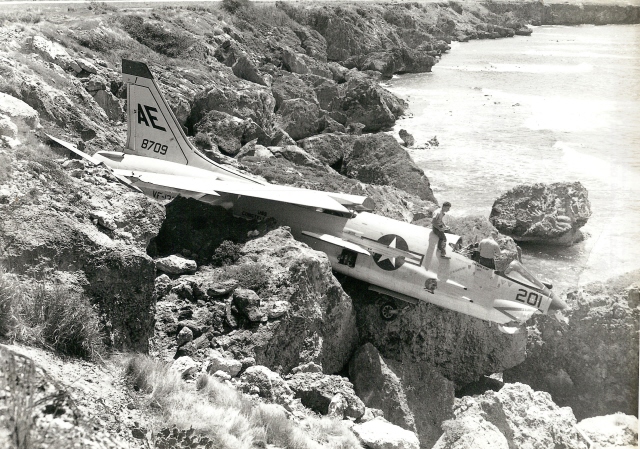
F8U-2 BuNo 148709 VF-132 Pilot Lt R. Loomis' crash at Leeward Point Field Guantanamo Bay Cuba ---US Navy Photo courtesy Bruce Nason
[(3/7/13): Here is the account of the accident]: In response to the comments and picture of the F-8 resting halfway down the cliff south of the Leeward Point runway, I believe I can provide some info for those who might be curious as the facts surrounding the occurrence. I had hoped that Bob Loomis might respond, but I cannot find out where he is and if he is still around. The last time I saw him was at at a LACB in San Diego in the '90's, and I know of no one who has had any contact with him since.
This occurred in April of 1962 when VF-132, as part of CAG-13 under George Watkins, was shaking down Connie in the Gitmo area. My logbook shows my first landings on Connie on 28 February and the first days of March, then we were based ashore at Leeward until early April, and flew the rest of that month from the ship. My last landing on the ship was on 3 May, and I got a total of 23 traps, 4 at night. We flew daily gunnery hops ashore as well as providing services for ship controllers. During our time there Bob Loomis, Tom Scott and I flew to Roosie Roads for a weekend. After a couple of weeks the ship started some limited cyclic ops, with each squadron getting around 12 sorties/day. There were no CQ sessions, all flights were regular cycles. We started night flying after about ten days and these launches were limited to couple of birds of each type. We lost 2 birds in these evolutions. The first was when CAG, flying "Double Nuts", took a high dip, landed on his nose wheel, collapsing it, boltering, and in the process flattening his intake duct, which prompted a near-simultaneous burner light and flame-out just off the angle. He punched out and was picked up promptly by the helo. I was on the AAR board, not a difficult investigation, with the combination of plat tapes and a conspicuous ever widening stripe of gray paint, which began just past the 4-wire and continued until it was exactly the width of an F-8 intake duct, about halfway up the angle. This was his third flight of the day, the others being in a Spad and an A4.
Bob Loomis collapsed his right main mount one night and boltered, which led to his being ordered to bingo to Leeward and effect a short field arrestment. I remember being in the ready room and commenting to anybody who was there that somebody better make sure he gets the word to land east west to get a decent straightaway and so that if he's pulled off the runway he'll have plenty of unobstructed space available. Guess what! The duty officer ordered him to make his approach west to east. The result was he engaged the gear OK, shut down the engine, and the drag from the right side took him off the runway right about at the 3000' mark, where there's only about 60' of space between the runway and the cliff. He blew the canopy, the a/c went over the side and stayed upright. When all the crashing stopped, he said there was silence and darkness. He looked over the side before he attempted to egress and could see white water below him. Crash crew arrived and got some light on him and his surroundings, and he realized he was about 20' or more above the rocks. He crawled back on the fuselage to where he could egress via the tail section with help from the crash personnel. The Ops duty officer stated that he didn't want an a/c sliding off the runway and endangering planes parked on the ramp to the north of the taxiway. It didn't make any sense to me then and it still doesn't. You'd have to keep the power on to slide that far. Google the Leeward runway and you'll see what I mean. That night Bob was quoted as saying he'd invented a new name for a Happy Hour drink, the "2N on the Rocks".---John Holm
Spectacular Accidents and Amazing Rescues
[Version #1]About 15 years ago I had a fascinating conversation with [the late] Ron Luther where he related his experience in going off the business end of the carrier (Independence) Stayed in the cockpit and went
underneath the ship and through one of the screws, which chopped the F8 into 3 pieces. He said he popped out the other end of the carrier, and was rescued from his third of the F8, which was semi floating. --Willy Carroll
[Version #2] Turns out, I was aboard on that same lousy dragged-out qual cruise, having gone off the front end of that same boat on a "non-shot" a couple nights earlier - 28 Feb to be exact - and after having been picked up by the destroyer USS Manley, DD 940 -- and riding her for about 36 hours
until the WX was suitable for helo-by-sling lift back to Independence, got back on board around noon on 2 March, waiting around to finish my last couple night traps.
Ron was still somewhere along the line of getting the required six night traps – had one or two traps that finished with noticeable right to left drift on final and rollout. Not sure which attempt it was, but on the bad one, he came across the ramp drifting more left across the centerline, and when he caught a wire, dragged it out well to port, and with the hook attached, went over the port side. So the a/c hung up there momentarily, before dropping off the deck edge somewhere just short of the aft end of the deck edge elevator. Somehow, he ended up in the water, having seriously injured his left shoulder -- and had a tear in his poopy suit - water was cold, but no recall of temp.
Once again, Manley to the rescue, and picked him up. Having just got back aboard from Manley myself that forenoon, and still being evaluated by the Flight Surgeon myself, got in on the debrief, where Ron and I compared notes on how the Destroyer sailors had treated us - (which was great). At that time, Ron told us that he had opened the canopy, and managed to drop out of the cockpit from some unknown height below the flight deck - having apparently torn his poopy suit, but most disturbing, had landed hard on his left shoulder, and found it more or less useless. Sure enough, he would demonstrate that his arm just sort of "hung there."
Back then we understood that Ron's machine had dropped clear of the ship and sunk in the wake, and that Manley had retrieved him - very cold, and with the useless left arm. --Bill Brandel
[Webmaster's Note: Regardless of which version is correct, escaping from a sinking Crusader is a tricky act. See photos above. To see a video of a similar bad trap of a FA-18, go to "Odds 'n Ends" Page 4]

 YouTube Audio: (1/25/25) VFP-62 RF-8's burst Canopy causes emergency landing aboard USS. Enterprise (CVA-65)